Published by CarHub | Automotive News & Insights
Few SUVs combine family-friendly practicality with American muscle-car performance quite like the Dodge Durango. Since its introduction for the 1998 model year, the Durango has evolved from a rugged, truck-based SUV into a powerful three-row vehicle offering modern technology, everyday versatility, and serious V8 performance.
From its early V8-powered models to the high-performance SRT 392 and supercharged SRT Hellcat, the Dodge Durango has built a reputation for delivering something different in the SUV segment.
So, how did this iconic Dodge SUV evolve over the years? Let’s explore the generations, engines, and performance milestones that helped shape the Durango’s legacy.
First Generation (1998–2003): Where the Durango Began
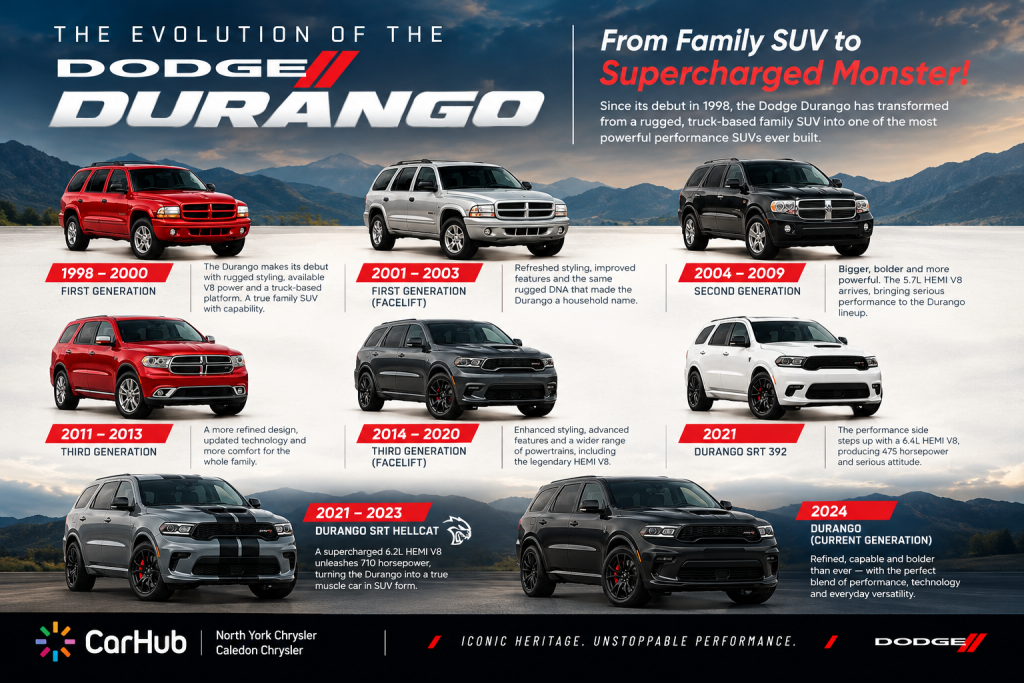
The first-generation Dodge Durango arrived for the 1998 model year, combining rugged styling with the practicality families wanted from an SUV.
Built on a truck-based platform, it offered a traditional SUV driving experience, with available V8 engines delivering the power expected from Dodge. Its spacious cabin, substantial road presence, and towing capability made it appealing to families and drivers who needed more than a conventional passenger vehicle.
The first Durango established the formula that would define the nameplate: useful space, bold styling, and the option of V8 power.
What made it special?
- Rugged, truck-based construction
- Available V8 power
- Three-row seating availability, depending on configuration
- Practical utility for family trips and towing
Second Generation (2004–2009): Bigger, Bolder, and More Powerful
For the 2004 model year, Dodge introduced a larger, redesigned Durango with a more substantial exterior and an expanded focus on space and capability.
This generation also marked an important milestone for the Durango’s performance identity: the 5.7L HEMI V8 became available for the 2004 model year, bringing classic HEMI character to Dodge’s three-row SUV.
The combination of available V8 power, family-oriented space, and strong towing capability helped establish the Durango as more than just a practical people mover.
For drivers who appreciated traditional American SUV styling and a powerful engine, the second generation became an important chapter in the Durango story.
Third Generation (2011–Present): Modern Technology Meets Muscle
The third-generation Dodge Durango arrived for the 2011 model year and brought a more refined design, a more modern cabin, and technology suited to everyday driving.
Over the years, Dodge continued to update its infotainment systems, interior features, styling, and available powertrains. The lineup offered different options for different drivers, from the Pentastar V6 to the 5.7L HEMI V8.
This generation also became the foundation for the Durango’s most ambitious performance models, including the SRT 392 and SRT Hellcat.
The result? An SUV that could handle school runs, road trips, and towing duties while offering performance that was once more commonly associated with sports cars.
Dodge Durango SRT 392: Performance Takes Centre Stage
The Dodge Durango SRT 392 took the performance side of the SUV to another level.
Powered by a naturally aspirated 6.4L HEMI V8, the SRT 392 produces 475 horsepower and 470 lb-ft of torque in the relevant model configurations.
Performance-focused engineering, distinctive SRT styling, upgraded braking components, and a sportier driving character helped separate it from more conventional family SUVs.
Yet the Durango retained its three-row layout and everyday versatility, giving drivers a combination of performance and practicality that made it stand out.
For enthusiasts who want V8 character without stepping up to a supercharged Hellcat, the SRT 392 represents a compelling part of the Durango legacy.
Dodge Durango SRT Hellcat: The 710-HP Game Changer
If the SRT 392 demonstrated what the Durango could do, the SRT Hellcat pushed the concept into another league.
First introduced for the 2021 model year, the Dodge Durango SRT Hellcat features a supercharged 6.2L HEMI V8 producing 710 horsepower and 645 lb-ft of torque.
Dodge’s published performance figures include a 0–60 mph time of approximately 3.5 seconds and an NHRA-certified quarter-mile time of 11.5 seconds for the specified model.
Those numbers put the Hellcat firmly in high-performance territory, despite its substantial size and three-row SUV configuration.
The Hellcat was initially introduced as a one-year model for 2021, before returning for the 2023 model year following strong enthusiast demand. Dodge continued offering Hellcat versions in subsequent model years.
Why does the Durango SRT Hellcat stand out?
- Supercharged 6.2L HEMI V8
- 710 horsepower and 645 lb-ft of torque
- Performance-oriented all-wheel-drive configuration
- Aggressive exterior styling and SRT details
- Three-row SUV versatility combined with extraordinary acceleration
The Hellcat captures the Durango’s unique appeal: a vehicle capable of carrying passengers and cargo while delivering the kind of power usually associated with dedicated performance cars.
How Has the Dodge Durango Changed Over the Years?
| Generation or model | Defining characteristic |
|---|---|
| First generation (1998–2003) | Rugged, truck-based SUV roots |
| Second generation (2004–2009) | Larger design and available 5.7L HEMI V8 |
| Third generation (2011 onward) | Modern technology, refinement, and varied powertrains |
| Durango SRT 392 | Naturally aspirated 6.4L HEMI V8 with 475 horsepower |
| Durango SRT Hellcat | Supercharged 6.2L HEMI V8 with 710 horsepower |
Specifications can vary by model year, trim, and equipment. The SRT 392 and SRT Hellcat are performance versions within the broader Durango lineup rather than separate generations.
The Modern Dodge Durango: Practicality Meets Power
The Durango’s appeal goes beyond horsepower figures. Depending on the model and configuration, drivers can enjoy three-row seating, flexible cargo space, available all-wheel drive, towing capability, and modern connectivity features.
The available engine choices have also allowed the Durango to serve a wide range of drivers. A V6-powered model may suit someone prioritizing everyday family use, while a HEMI V8 or SRT model appeals to those looking for stronger performance.
For shoppers considering a pre-owned Dodge Durango, the right choice depends on priorities such as budget, mileage, fuel consumption, passenger needs, towing requirements, and maintenance costs.
A well-maintained vehicle with the right features for your lifestyle may be a better fit than simply choosing the model with the highest horsepower.
Which Dodge Durango Would You Choose?
From the rugged first-generation models to the unmistakable supercharged SRT Hellcat, the Dodge Durango has continued to evolve while maintaining its bold personality.
Would you choose the classic styling of the early Durango, the traditional HEMI V8 experience, the balanced performance of the SRT 392, or the 710-horsepower SRT Hellcat?
Whatever your preference, the Durango’s history demonstrates how an SUV can combine family practicality with a distinctive performance identity.
Explore Your Next Vehicle with CarHub
At CarHub, we’re passionate about helping drivers explore vehicles that suit their needs and interests. Whether you’re searching for a versatile family SUV, a capable V8-powered vehicle, or your next pre-owned Dodge, our team can help you explore available options.
Browse our inventory at CarHub.ca and discover your next drive.
CarHub — Your destination for automotive insights and vehicle shopping.
Specifications and performance figures are based on manufacturer information for the relevant model years. Features, availability, and equipment vary by vehicle. Always confirm the specifications of the specific vehicle you are considering.
Sources: Dodge Canada and Stellantis North America manufacturer information. See the official Dodge Durango performance page and Stellantis’ Durango history and HEMI anniversary announcement.