Choose the Ram 1500 when commuting, passengers and general pickup duties make up most of your driving, provided its ratings cover your loads. Choose the Ram 2500 when heavier trailers, bed loads or work equipment require more capability. The deciding factor is your loaded setup, not simply how often you tow.
At CarHub North York Chrysler and CarHub Caledon Chrysler, we help GTA drivers compare both trucks around their everyday routes and the most demanding jobs they need to handle.
Two Pickups Built Around Different Priorities
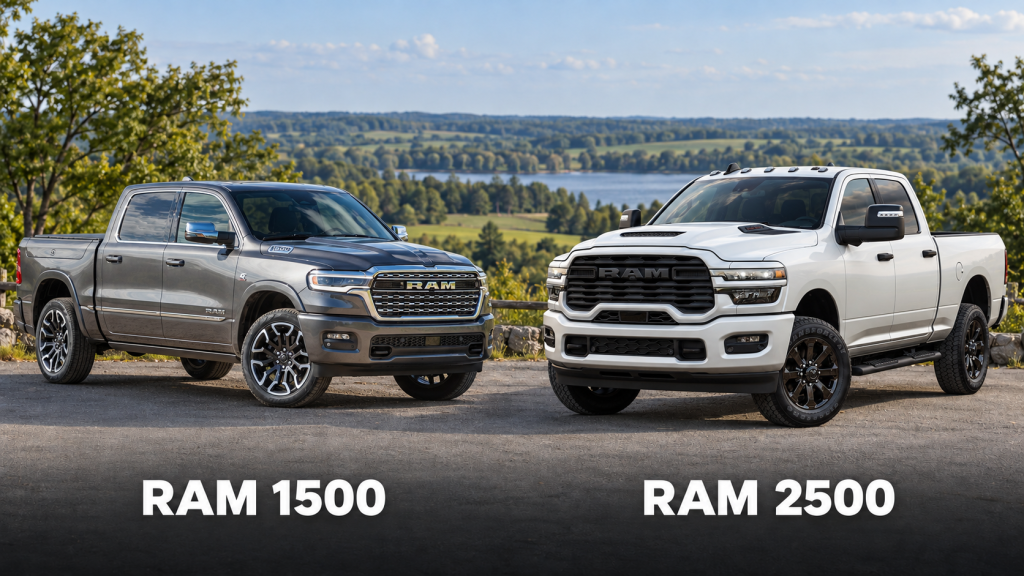
The Ram 1500 is a light-duty pickup with a strong focus on everyday versatility. It combines passenger comfort with a useful bed and towing capability for properly matched trailers.
The Ram 2500 is a heavy-duty pickup designed for more demanding loads. Its appeal grows when equipment, materials or a larger trailer become central to how you use your truck.
Both offer comfortable cabins and a range of equipment. Choosing the 2500 does not mean giving up comfort, and choosing the 1500 does not mean giving up useful towing capability. The question is which truck supports your work while fitting the rest of your life.
Ram 1500 vs Ram 2500: The Differences That Affect Your Choice
Engine, cab and equipment availability vary by model year. This comparison describes the main choices found across recent Canadian models; confirm the specifications of the individual trucks you are considering.
| What matters | Ram 1500 | Ram 2500 |
|---|---|---|
| Truck category | Light-duty pickup. | Heavy-duty pickup. |
| Main buying reason | Everyday driving combined with hauling and suitable trailer duties. | More demanding towing and carrying requirements. |
| Gasoline engines | 3.6L Pentastar V6, 5.7L HEMI V8 and 3.0L Hurricane inline-six options, depending on year and configuration. | 6.4L HEMI V8 in recent models. |
| Diesel choice | 3.0L EcoDiesel V6 in certain earlier used models. | Available 6.7L Cummins turbo-diesel inline-six; output varies by model year. |
| Cab choices | Crew Cab and Quad Cab in recent lineups; older and Classic configurations differ. | Regular Cab, Crew Cab and Mega Cab, depending on year and trim. |
| Suspension | Rear coil springs; available four-corner air suspension on equipped models. | Heavy-duty rear coil suspension; available rear air suspension on equipped models. |
| Towing and payload | Check that the specific truck covers your complete load. | A higher-capacity range, but engine and equipment still affect the individual rating. |
Start with the Trailer, Then Count What Goes in the Truck
A trailer’s loaded weight is only the first part of the comparison. Passengers, tools, luggage, hitch equipment and trailer tongue or pin weight also place demands on the truck.
This is where a Ram 2500 deserves a closer look. A trailer might fall within a Ram 1500’s tow rating while the combined weight carried by the truck leaves too little payload for your full trip.
Before choosing either model, establish:
- The trailer’s expected loaded weight.
- Tongue weight or fifth-wheel pin weight.
- Passenger and cargo weight.
- Added accessories, tools and hitch equipment.
- The truck’s towing, payload, axle and combined-weight limits.
A larger tow rating does not settle the entire match. Review all applicable ratings for the exact configuration.
For a small trailer used with modest cargo, a suitable Ram 1500 may cover the job. For a heavier equipment trailer or a camper with substantial pin weight, start comparing heavy-duty configurations. Even a Ram 2500 must be checked against the actual load.
Think About the Days You Drive Without a Trailer
A truck that tows on weekends still needs to work for weekday errands, commuting and parking.
We would start with the Ram 1500 if most of your time is spent travelling through Thornhill, North York or Vaughan with passengers and an empty or lightly loaded bed. Its light-duty role makes it a sensible first comparison when maximum carrying capacity is not the priority.
A Ram 2500 brings heavier-duty running gear, and the unloaded ride can feel firmer. Drive both over similar roads before deciding. Wheel and tire choices, suspension equipment and condition all influence comfort.
Compare the actual dimensions, too. Cab and bed combinations affect length, so the model badge alone does not tell you which truck fits your garage or parking space.
Gasoline or Diesel Changes the Ram 2500 Decision
Moving to a Ram 2500 does not require choosing diesel. Its 6.4L HEMI V8 offers a gasoline route into heavy-duty capability.
The available 6.7L Cummins turbo diesel is worth comparing when substantial towing is a central requirement. Equipped diesel trucks also offer exhaust-braking capability, which helps manage speed on descents when used as directed.
Engine choice brings trade-offs. Diesel equipment adds weight, and a diesel truck can have less available payload than a comparable gasoline configuration. Check the labels rather than assuming the diesel wins every capacity comparison.
Fuel, maintenance and operating patterns also belong in the decision. Consider your annual distance, trip lengths and loaded use, then compare the applicable service requirements. Diesel is not an automatic saving for every owner.
Choose Capability Before Choosing the Luxury Package
Both trucks offer trims with upgraded seating, technology and cabin finishes. A luxury Ram 1500 does not become a heavy-duty truck because it has more features, and a well-equipped Ram 2500 still needs sufficient payload for your plans.
Settle the work requirements first, then choose the cabin equipment you want.
For example, a family that uses a pickup for commuting and a properly matched holiday trailer may find the Ram 1500 fits well. A contractor carrying equipment while towing a work trailer has a different starting point, even if both buyers want the same comfort features.
Accessories matter as well. Bed caps, toolboxes and other additions use payload and can change how the truck suits your load.
Compare Both Trucks Against Your Actual Week
Choose the Ram 1500 when its verified capacity covers your work and you value a pickup suited to mixed everyday use. Move the Ram 2500 higher on your shortlist when heavier loads make heavy-duty capability necessary.
Bring your trailer information, passenger needs and regular cargo details to CarHub North York Chrysler or CarHub Caledon Chrysler. We can help you compare the configurations you are considering.
Explore our Ram truck inventory and contact our team to arrange a test drive of the models that fit your requirements.
Ram 1500 vs Ram 2500: Frequently Asked Questions
Does “three-quarter-ton” describe the Ram 2500’s actual payload?
No. It is a traditional truck-category label. The actual payload is specific to the vehicle and its equipment. Use the truck’s labels and manufacturer information rather than converting the category name into a carrying limit.
Does air suspension increase towing or payload ratings?
No. Levelling the truck does not raise its rated towing, payload or axle limits. Air suspension can help manage ride height on equipped trucks, but it does not make an overloaded setup acceptable.
Is a Ram 2500 automatically better in winter?
No. Tires, drivetrain, loading, road conditions and driving technique matter for both trucks. Heavy-duty classification does not guarantee better braking or traction. Compare the individual truck’s equipment and use suitable winter tires.
Can a Ram 2500 be used as a family vehicle?
A suitably configured Crew Cab or Mega Cab can accommodate family use. Check passenger access, child-seat fit, ride comfort and parking requirements in person. Its heavy-duty capability makes the most sense when your towing or hauling needs justify it.
Request More Info
Fill in the form below and our team will be in touch shortly.